

The Northern Machine
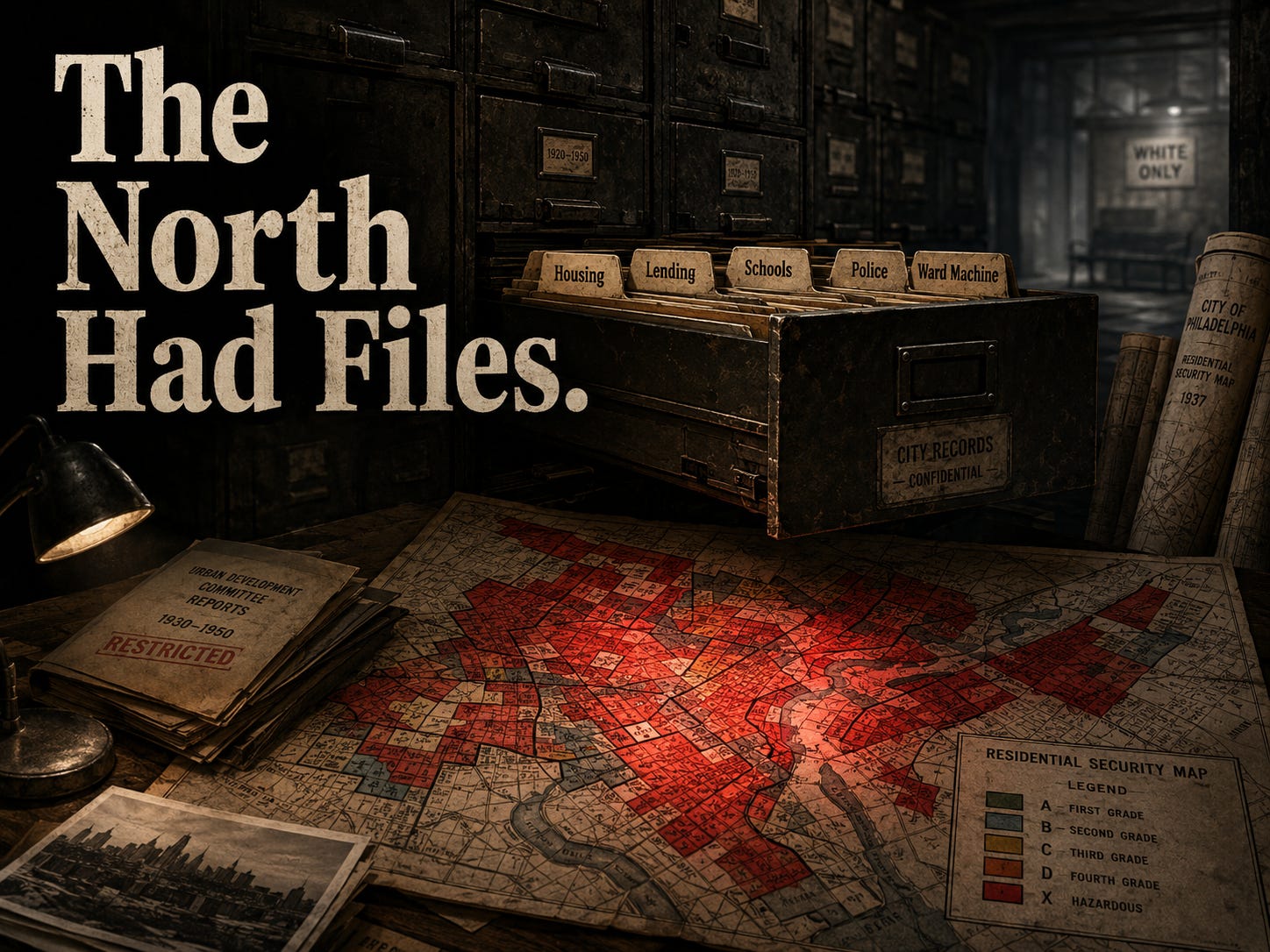
The North Had Files

The South made racial power easy to see.
That does not mean the North was innocent.
It means the North was better at hiding the machinery.
In the early twentieth-century South, racial hierarchy often announced itself in statute books, courthouse rules, train cars, school systems, primaries, and signs over doors. Jim Crow did not whisper. It governed. It wrote racial separation into law and then dared the country to call barbarism by its proper name.
The North preferred cleaner hands.
It did not always need a “White Only” sign when it had a bank officer, a zoning board, a ward boss, a school boundary, a police department, a union gatekeeper, a restrictive covenant, and a real estate map that could accomplish the same result without looking quite so primitive.
That was the trick.
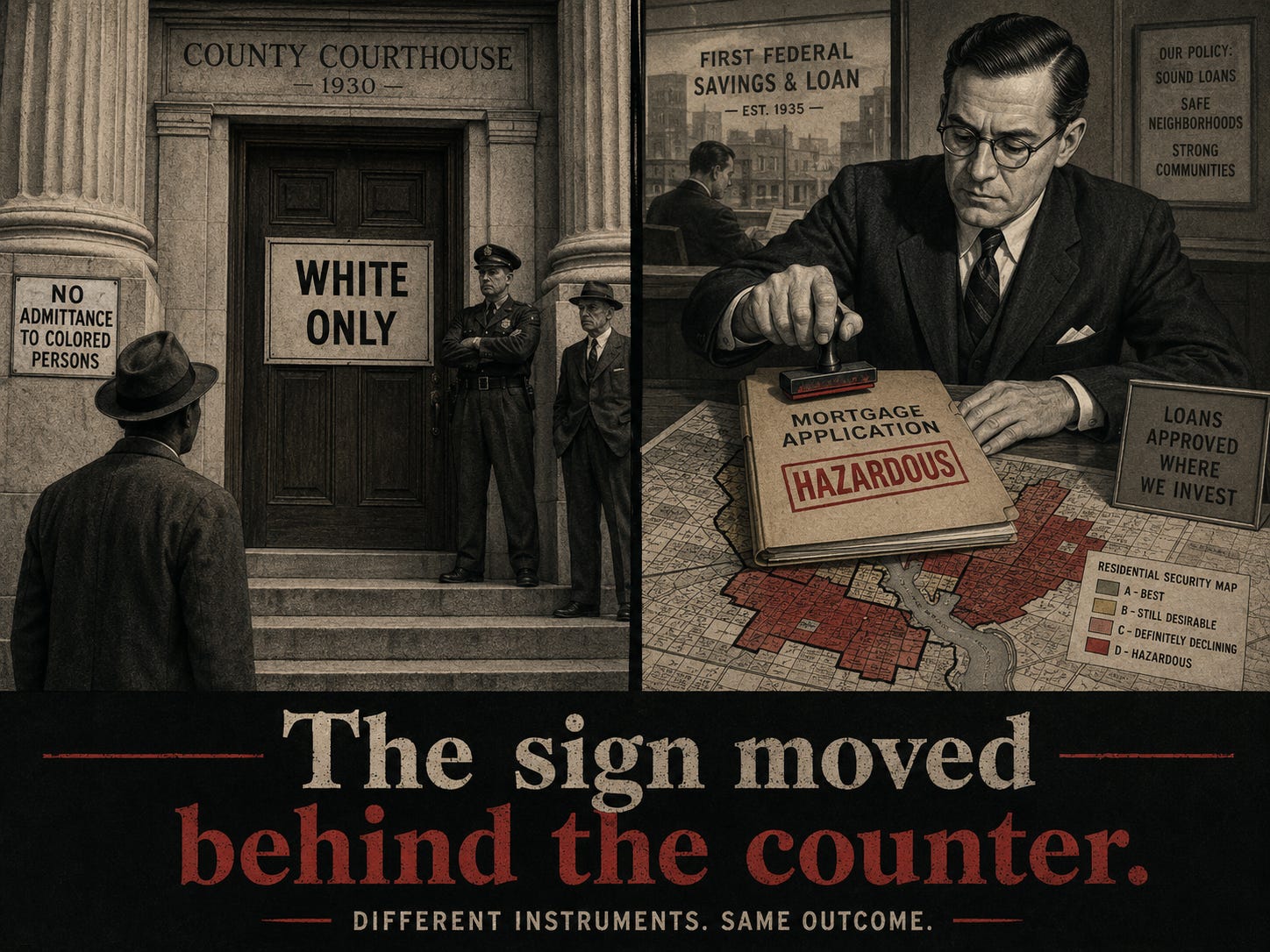
The South made racial hierarchy visible. The North made racial hierarchy deniable.
And deniable power is still power.
The earlier article argued that American political history cannot be reduced to fairy tales about permanent party virtue or permanent party guilt. Political parties are coalitions, not sacred bloodlines. They are machines for acquiring, preserving, and spending power. The honest question is never what a party says about itself. The honest question is what the people who control the machinery actually do with it.
Apply that same test to the North, and the museum-label version of history starts to crack.
The South shows racial hierarchy through formal law.
The North shows racial hierarchy through administration, housing, labor, policing, education, finance, and political management.
Different instruments.
Same question.
Who controlled the machinery?
I. The North Did Not Need Jim Crow to Produce Segregation
The South wrote racial hierarchy directly into law.
The North often produced racial hierarchy through systems that looked neutral until someone followed the consequences.
That distinction matters. It is also where Northern self-congratulation becomes unbearable.
Northern cities could point southward and say, “We do not have Jim Crow.” Fine. But many of those same cities had segregated neighborhoods, overcrowded Black districts, discriminatory lending, restrictive covenants, school separation by neighborhood, job barriers, police harassment, and political machines that knew exactly how to harvest votes without surrendering control.
That is not innocence.
That is a different architecture.
During the Great Migration, millions of Black Americans left the South seeking industrial jobs, voting rights, safety, wages, and life beyond the formal Southern racial order. The National Archives estimates that about six million Black Americans moved throughout the United States from the 1910s to the 1970s, leaving Jim Crow, lynching, and racial oppression for opportunities in the North, Midwest, and West. But escape from the South did not mean entrance into equality. In Northern cities, Black migrants faced segregated housing, overcrowding, underemployment, crime, harassment by local whites, and harassment by law enforcement officials.
There is the Northern contradiction in one sentence: access to the ballot, but confinement in the neighborhood; access to the city, but not equal access to the city’s wealth; escape from Southern statute, but not from racial power.
The tool was housing.
Restrictive covenants told property owners who could and could not occupy a home. Redlining told banks and lenders which neighborhoods were safe for capital and which neighborhoods were to be starved. The National Archives notes that Black migrants encountered restrictive covenants and redlining, systems that created segregated neighborhoods and helped lay the foundation for present racial wealth disparities.
That was not an accident.
That was policy wearing a banker’s suit.
The University of Richmond’s Mapping Inequality project describes redlining as the categorical denial of mortgage access not merely to individuals, but to whole neighborhoods. Between 1935 and 1940, federal housing maps classified neighborhoods by perceived lending risk, and those classifications hardened existing racial and economic boundaries.
So let us be precise.
The North did not always need to say, “You may not live here because you are Black.”
It could say: this neighborhood is risky.
It could say: property values must be protected.
It could say: the school district lines are already drawn.
It could say: the bank has standards.
It could say: the union has rules.
It could say: the police are maintaining order.
It could say anything except the obvious.
And the obvious was this: racial power had moved from the sign over the door to the paperwork behind the counter.
The Federal Housing Administration’s own underwriting logic helped harden the point. The FHA Underwriting Manual treated racial separation as a condition of neighborhood stability.
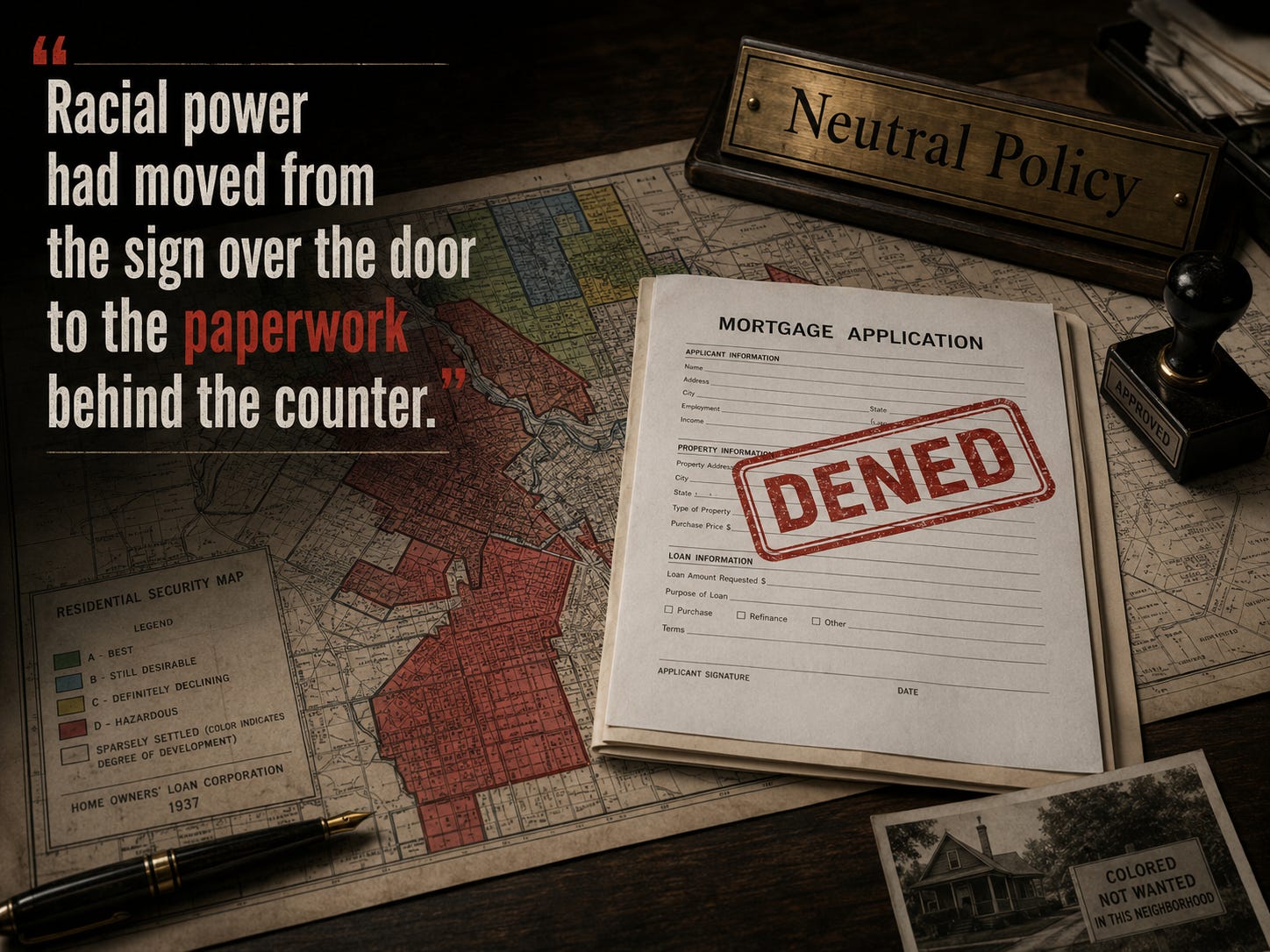
One summary of the manual notes that an “effective deed restriction” could include “the prohibition of the occupancy of properties except by the race for which they were intended.” The same material notes that the manual warned against schools attended by “inharmonious racial groups.”
There it is.
Not a burning cross.
Not a sheriff blocking a courthouse door.
A file.
A manual.
A professional standard.
A government-backed mortgage system teaching the market how to segregate with a straight face.
II. Northern Machines Managed Race Through Housing, Labor, Patronage, and Votes
Southern machines often maintained racial power by excluding Black citizens from meaningful political participation.
Northern machines often operated differently.
They did not always exclude Black voters outright. In many places, they absorbed them. They counted them. They courted them. They promised them. They managed them.
That is not the same system as the Southern white primary.
But it is still a system.
The Northern political machine was built around patronage, ward control, ethnic blocs, labor alliances, city contracts, police discretion, and neighborhood management. Immigrant communities, unions, business interests, and later Black voters could all be folded into the machine, but not necessarily as equals. The machine could offer protection, jobs, favors, and access while still controlling the terms of political power.
The South often said: you cannot vote.
The North often said: you may vote, but we will decide how power is distributed after the votes are counted.
The South said: you cannot sit there.
The North said: you cannot buy there.
The South said: you cannot enter.
The North said: you cannot qualify.
The South used the courthouse door.
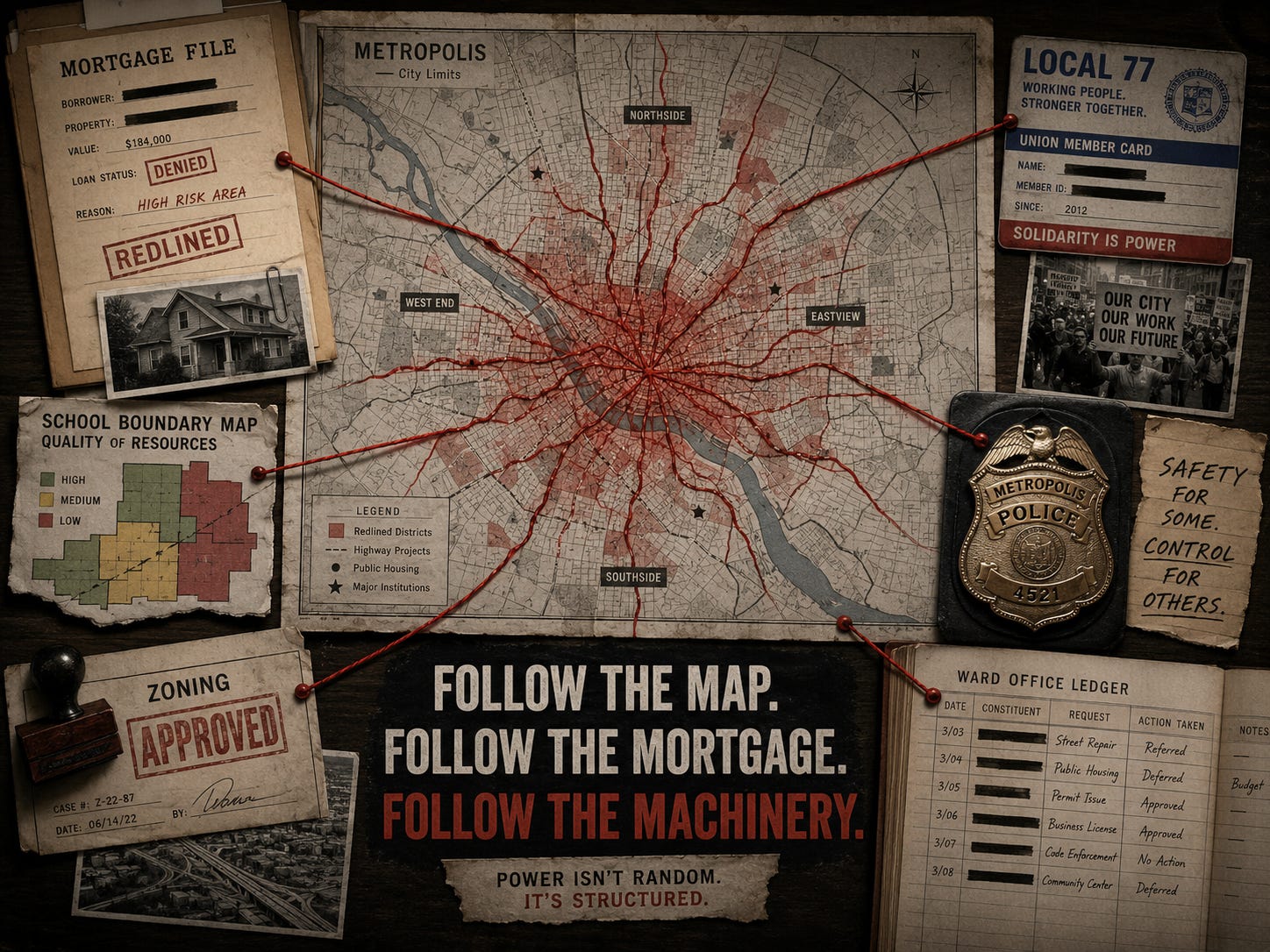
The North used the mortgage desk, the union hall, the school district, the zoning map, and the ward office.
This is why housing is not a side issue. Housing was the operating system. Once neighborhoods were racially confined, almost everything else followed: schools, property values, police presence, municipal services, business investment, generational wealth, and political leverage.
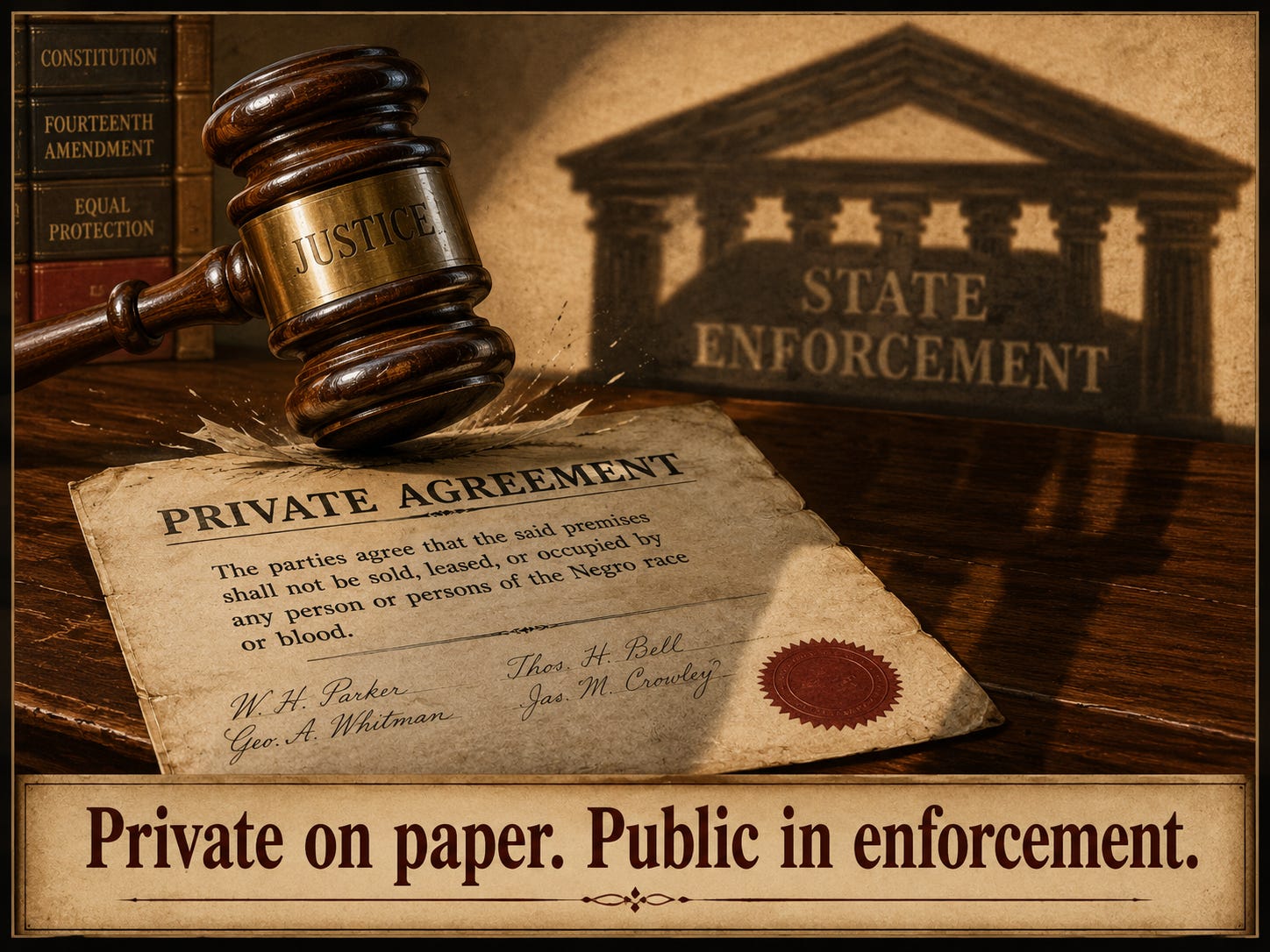
The Supreme Court eventually confronted one piece of this system in Shelley v. Kraemer, 334 U.S. 1 (1948). The Court held that racially restrictive covenants could not be enforced by state courts without violating the Fourteenth Amendment. Private parties could make discriminatory agreements, but the moment a court enforced them, state power entered the room. The Court put it plainly: “state action” existed “in the full and complete sense” when courts enforced those covenants.
That distinction matters.
The covenant may have been private on paper.
The enforcement was public.
And that is the broader Northern lesson: racial power often survived by laundering itself through supposedly private arrangements, then relying on public institutions to protect the result.
The legal history makes the evasion even clearer. In Buchanan v. Warley, 245 U.S. 60 (1917), the Supreme Court struck down a Louisville racial zoning ordinance that prevented Black occupancy in blocks where most residents were white. In other words, when direct racial zoning became constitutionally vulnerable, other instruments grew more valuable: covenants, lending standards, appraisals, maps, school boundaries, and “market” decisions that somehow kept producing the same racial geography.
That is how power adapts.
When one door closes, it finds another office.
The same pattern appeared in labor markets. Black workers arrived in Northern cities looking for industrial opportunity, but opportunity was often restricted by union exclusion, employer discrimination, job channeling, and workplace hierarchy. They could be used when labor was needed and contained when competition became inconvenient.
And when pressure built, Northern cities could explode while still congratulating themselves for not being the South. Detroit in 1943 is one brutal example. During World War II, Detroit’s industrial growth drew Black and white Southern migrants into a city already strained by housing shortages, job competition, discrimination, and police violence. The Detroit Historical Society records that the 1943 riot left nine whites and twenty-five African Americans dead; no whites were killed by police, while seventeen African Americans died at the hands of police violence.
That was not Mississippi.
That was Michigan.
Different accent.
Same machinery.
III. Northern Hypocrisy Proves the Problem Was National, Not Merely Southern
The point is not that the North was “just as bad as the South” in exactly the same way.
That would be lazy history.
The South had formal Jim Crow. The South had the white primary. The South had one-party racial law. The South had state-backed segregation written plainly into public life. The South had a level of explicit legal racial control that deserves its own indictment and does not need to be softened, blurred, or diluted.
But the North cannot be allowed to hide behind that indictment.
The North’s guilt was different.
The South made racial hierarchy visible.
The North made racial hierarchy deniable.
That is why the Northern story is necessary. It expands the argument from regional guilt to structural power. It shows that racial control in America was not merely a Southern disease. It was a national habit with regional dialects.
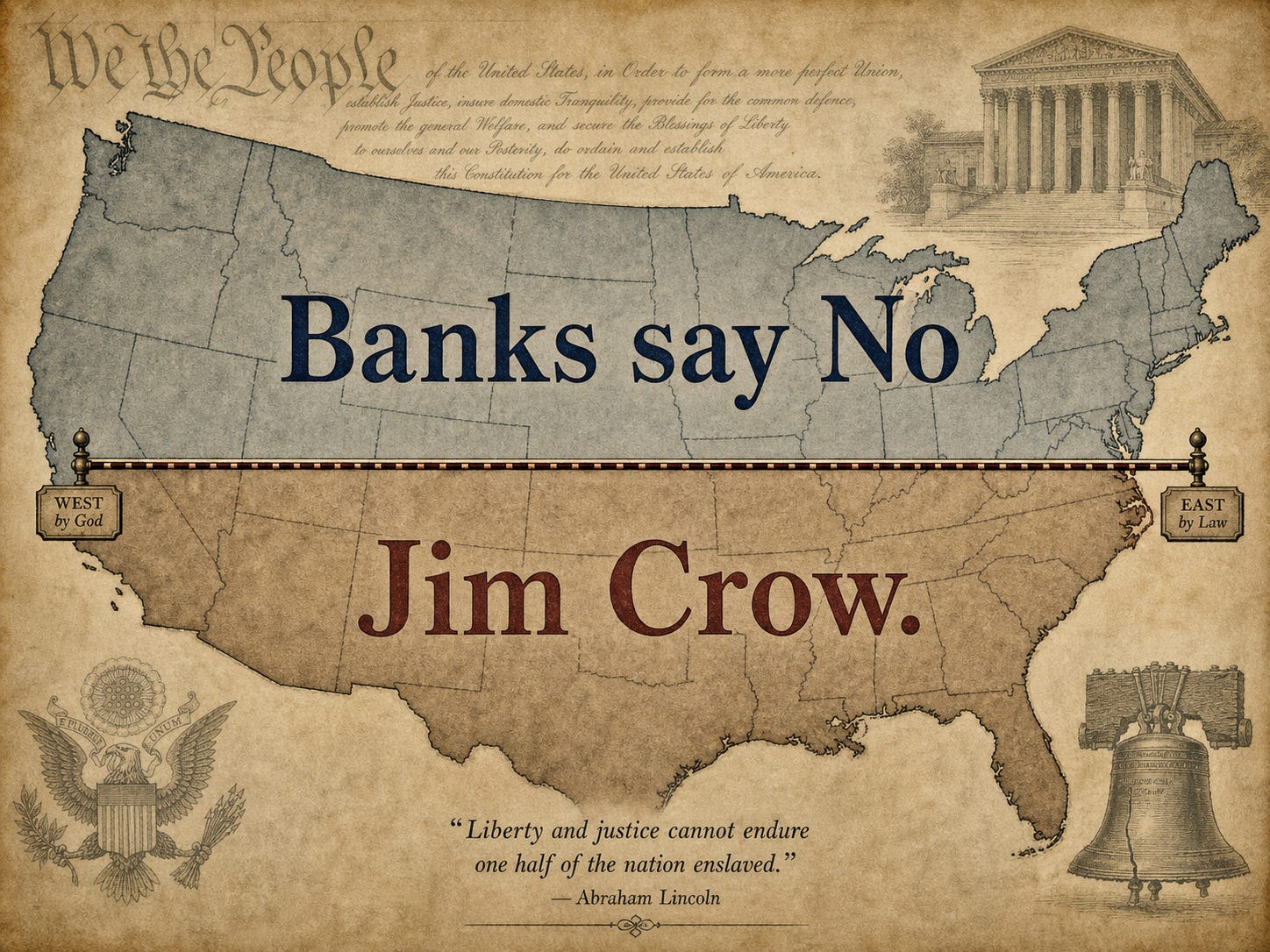
In the South, the language was statute.
In the North, the language was market.
In the South, the sign said “separate.”
In the North, the map said “hazardous.”
In the South, the registrar closed the ballot box.
In the North, the banker closed the neighborhood.
In the South, the sheriff enforced the order directly.
In the North, the police department enforced the boundaries after the order had already been built.
That is why this cannot become a cheap regional morality play. The first article exposed the lie that party labels carry permanent virtue or permanent guilt by themselves. This follow-up sharpens the same principle: virtue does not live in geography either.
Not in the North.
Not in the South.
Not in a party label.
Not in a slogan.
Power must be examined where it sits.
The earlier article’s central lesson was simple: follow power. Follow law. Follow the people who wrote the statutes, enforced the rules, blocked the bills, counted the votes, controlled the primaries, seated the delegates, appointed the judges, and decided which citizens would be heard and which citizens would be erased.
For the North, add a second command.
Follow the map.
Follow the mortgage.
Follow the deed restriction.
Follow the school boundary.
Follow the union card.
Follow the police beat.
Follow the ward boss.
Follow the zoning board.
Follow the bank file.
That is where the Northern myth collapses.
The North did not have to become Mississippi to be guilty. It only had to build systems that produced racial separation while calling those systems ordinary administration. It only had to pretend that neighborhoods just happened, schools just happened, lending patterns just happened, job access just happened, police boundaries just happened, and political dependency just happened.
They did not just happen.
They were made.
And once made, they reproduced power.
The Bottom Line
The South teaches one lesson.
The North teaches another.
The South shows what racial hierarchy looks like when it is written openly into law. The North shows what racial hierarchy looks like when it is hidden inside institutions that claim neutrality while producing predictable racial results.
The South had Jim Crow statutes.
The North had redlined maps.
The South had white primaries.
The North had ward machines.
The South had courthouse exclusion.
The North had housing confinement.
The South had signs.
The North had files.
So no, the North does not get to pose as the innocent witness to a Southern crime. It was not innocent. It was differently organized.
That is the point.
History is not a morality play where one region wears horns and the other wears a halo. That is school-board mythology. That is campaign memory. That is the kind of history written for people who want comfort instead of chronology.
The real history is harder.
The South wrote racial order into law.
The North built racial order into systems.
Both must be judged by the same standard: who controlled the machinery, and what did they do with it?
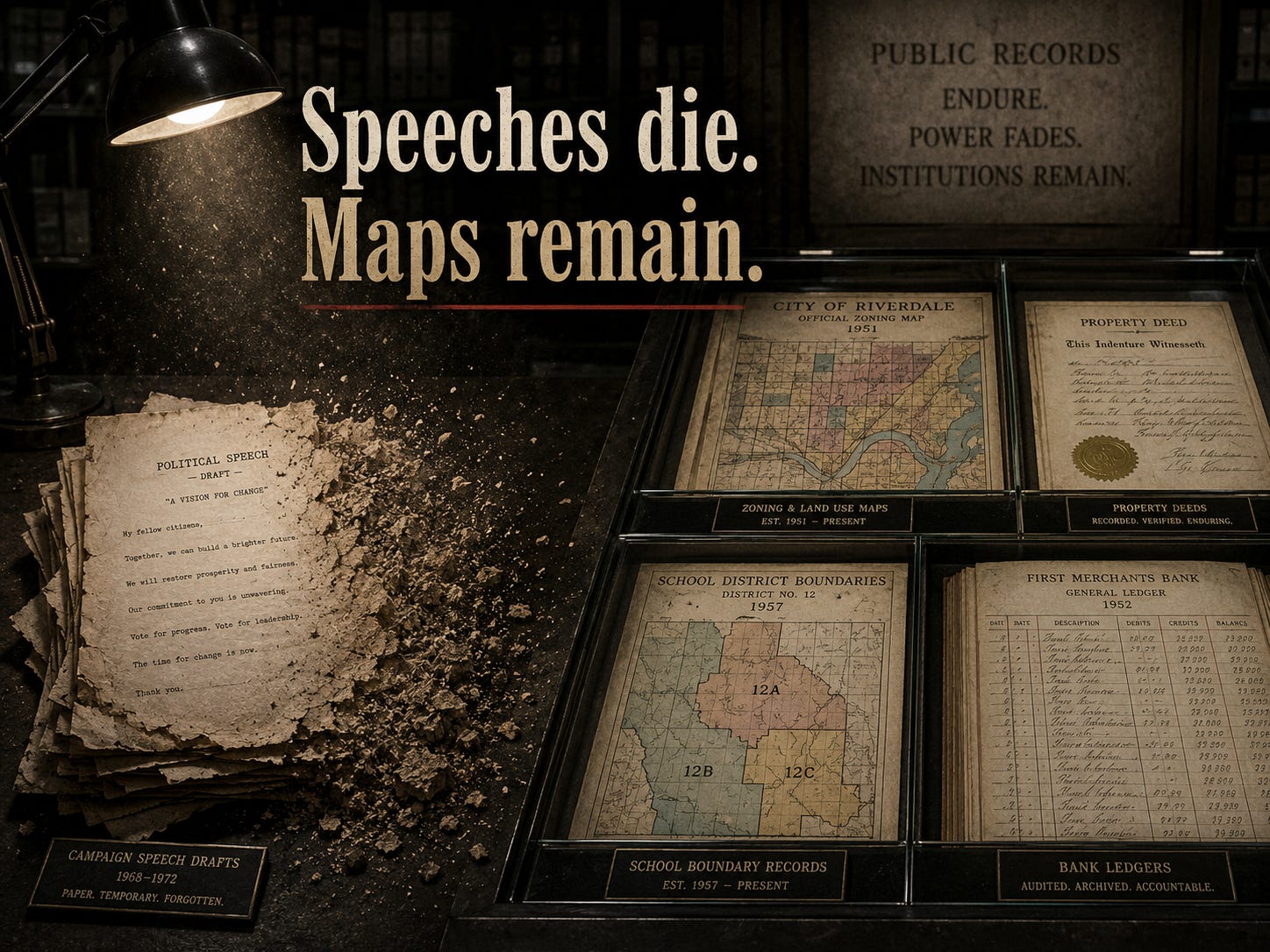
Speeches die.
Maps remain.
Statutes remain.
Deeds remain.
School lines remain.
Bank records remain.
And history waits, patiently and mercilessly, for anyone willing to read the machinery instead of the myth.
Or you can Buy Me a Coffee
Boston was one of the last major school districts to integrate. Their position was that it was not segregation but natural boundaries between schools. Today we hear black leaders (often Democrats) espouse policies that promote segregation. They seem to be doing that to maintain control of the black community. Segregation or self segregation of a minority group that struggles on most levels is not good for that group.