

The Tenth Amendment Isn’t Complicated—We Just Ignore It

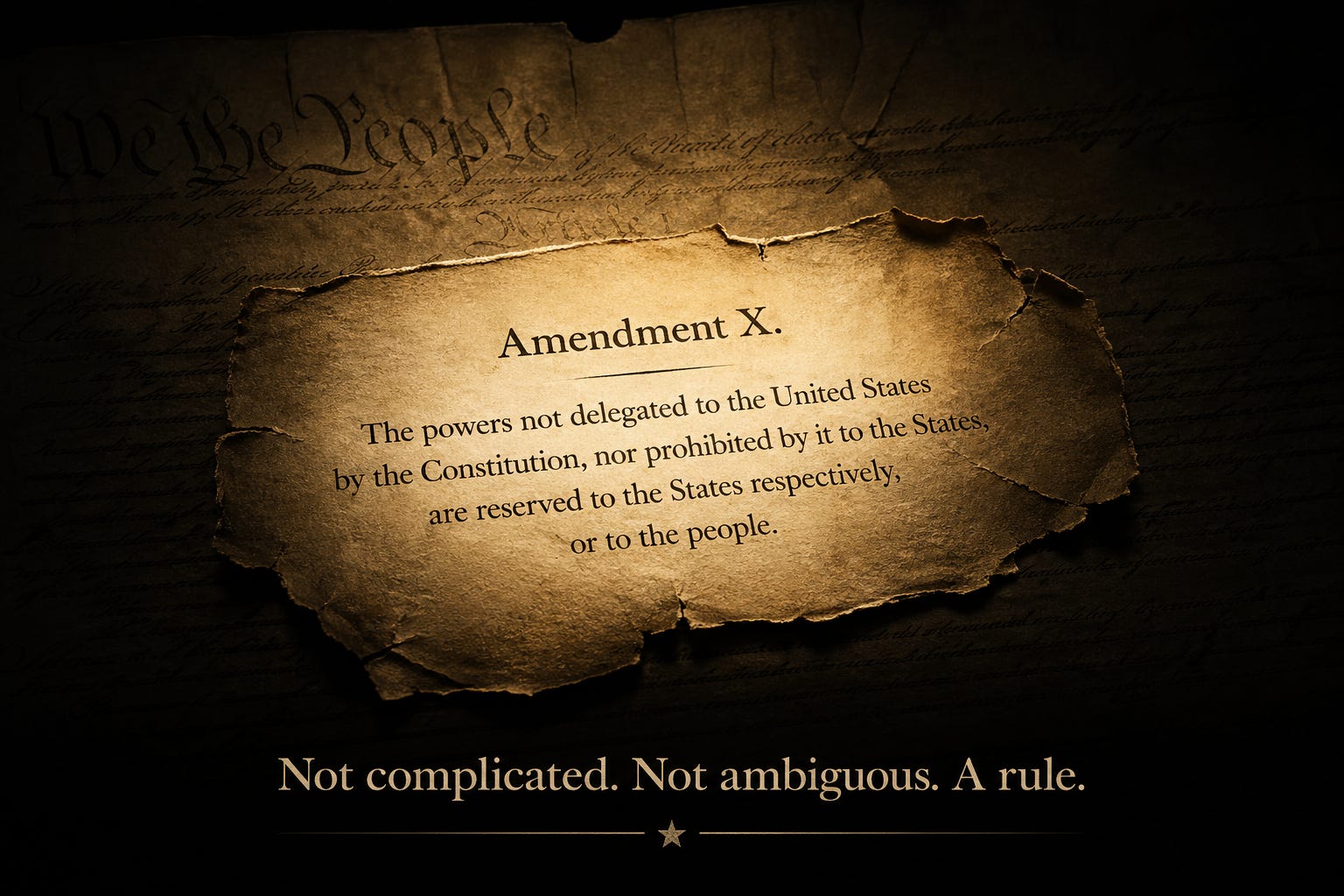
There are parts of the Constitution that invite debate, that require interpretation, that send lawyers and judges into long arguments over meaning and scope. The Tenth Amendment is not one of those parts. It does not speak in abstractions, it does not hedge its language, and it does not leave much room for creative reinterpretation. It states, with a level of clarity that borders on bluntness, that the powers not delegated to the United States by the Constitution, nor prohibited to the states, are reserved to the states respectively, or to the people.
That is not complicated. It is not ambiguous. It is not subtle.
It is a rule.
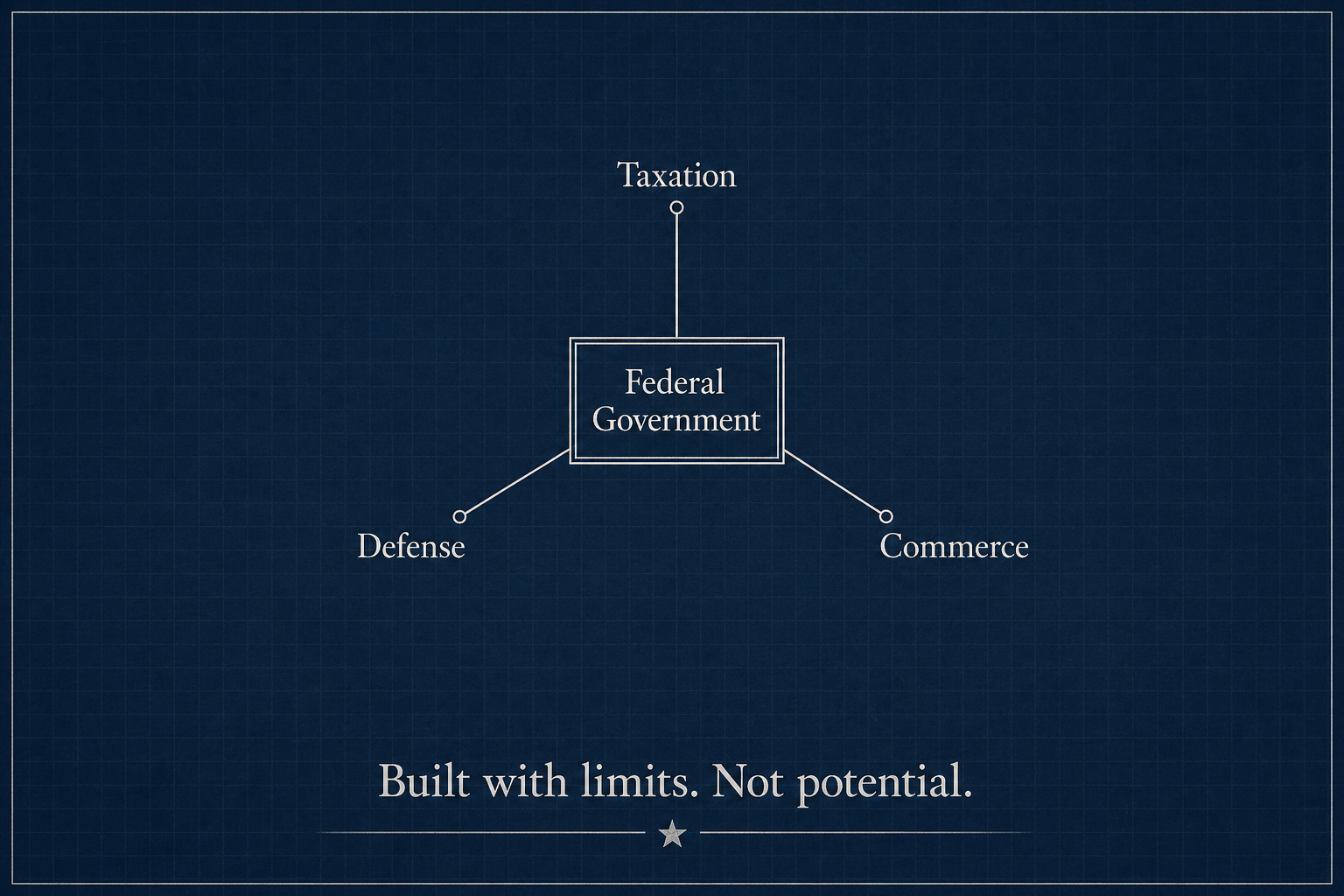
To understand the force of that rule, it is necessary to remember how the Constitution was structured in the first place. The federal government was not created as a general authority with broad, undefined powers. It was created as a government of enumerated powers, meaning that its authority was spelled out in advance, limited to what was expressly granted, and confined to those areas where a national government was considered necessary.
Everything else was deliberately left behind.
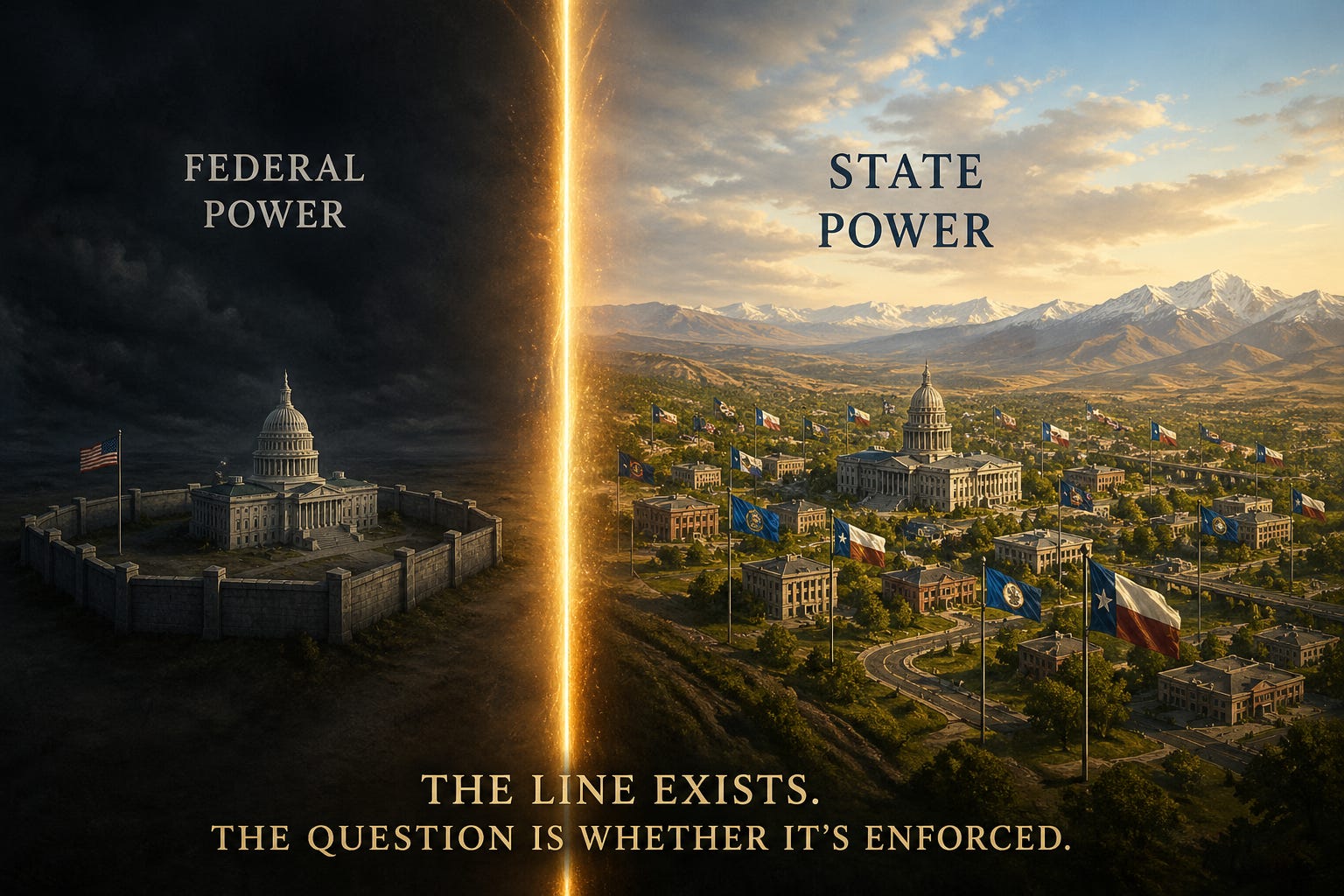
The states retained their own authority. The people retained theirs. And the line between them was not meant to shift depending on political convenience or perceived necessity. It was meant to hold.
As the Supreme Court has put it, the Constitution “withhold[s] from Congress a plenary police power,” leaving that general authority—over health, safety, welfare, and daily life—to the states (United States v. Lopez, 514 U.S. 549 (1995)). That division is not a technicality. It is the structure of federalism itself.
At the Founding, this structure was so well understood that some of the Framers questioned whether a Bill of Rights was even necessary. The argument, which sounds almost foreign today, was that the federal government had no power to infringe upon many of the rights people feared losing, because no such powers had been granted in the first place.
James Wilson made this point directly during the ratification debates, observing that “there is given to the general government no power whatsoever concerning” freedom of the press. Alexander Hamilton echoed the same concern in Federalist No. 84, warning that a Bill of Rights might be not only unnecessary but dangerous, because it could “afford a colorable pretext to claim more than were granted.” If you begin listing rights that the government cannot violate, the implication might arise that it possesses the power to violate them in the first place.
The logic is striking in its simplicity. Rights did not need to be protected from a government that lacked the authority to interfere with them.
That is how limited the federal government was intended to be.
The Tenth Amendment was added not to create that limitation, but to reaffirm it. It serves as a reminder—a kind of constitutional punctuation—that the enumeration of powers in the document is not illustrative. It is exhaustive. What has not been given has been withheld.
The Supreme Court later described the amendment as “but a truism” (United States v. Darby, 312 U.S. 100 (1941)), meaning that it does not grant new rights or impose new restrictions so much as it confirms what was already implicit in the structure of the Constitution. The federal government has only the powers it has been given. Everything else remains where it started.
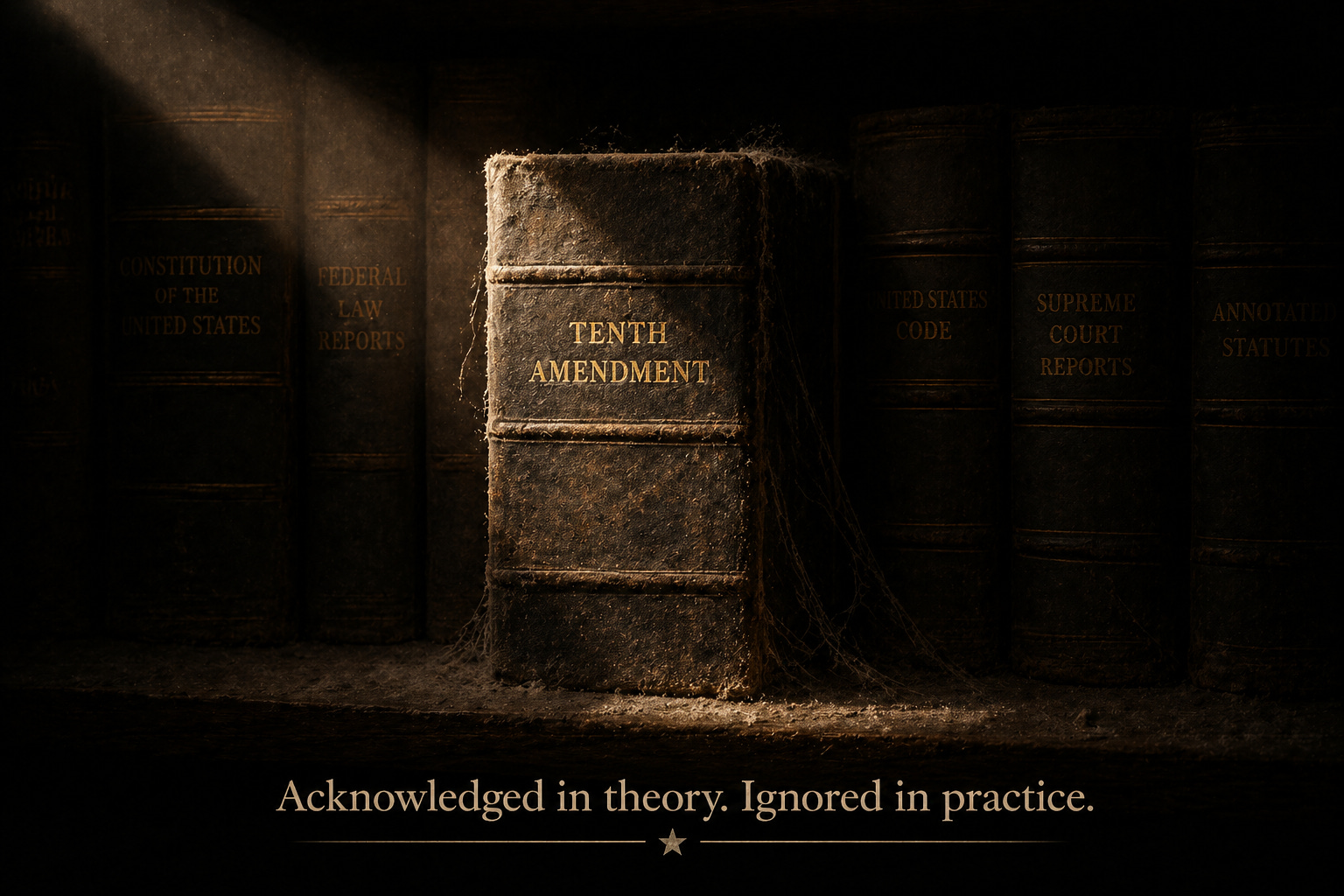
And yet, despite its clarity, the Tenth Amendment has become one of the most frequently cited and least followed provisions in the entire document.
The reason is not that its meaning is unclear. It is that its meaning is inconvenient.
Over time, the operating assumption of federal power has drifted away from the principle of enumeration and toward something much closer to a general authority. Instead of beginning with the question of whether a power has been delegated, the modern approach often begins with the assumption that federal action is permissible unless it can be shown to be prohibited.
This is not a subtle shift. It is a complete inversion of the constitutional design.
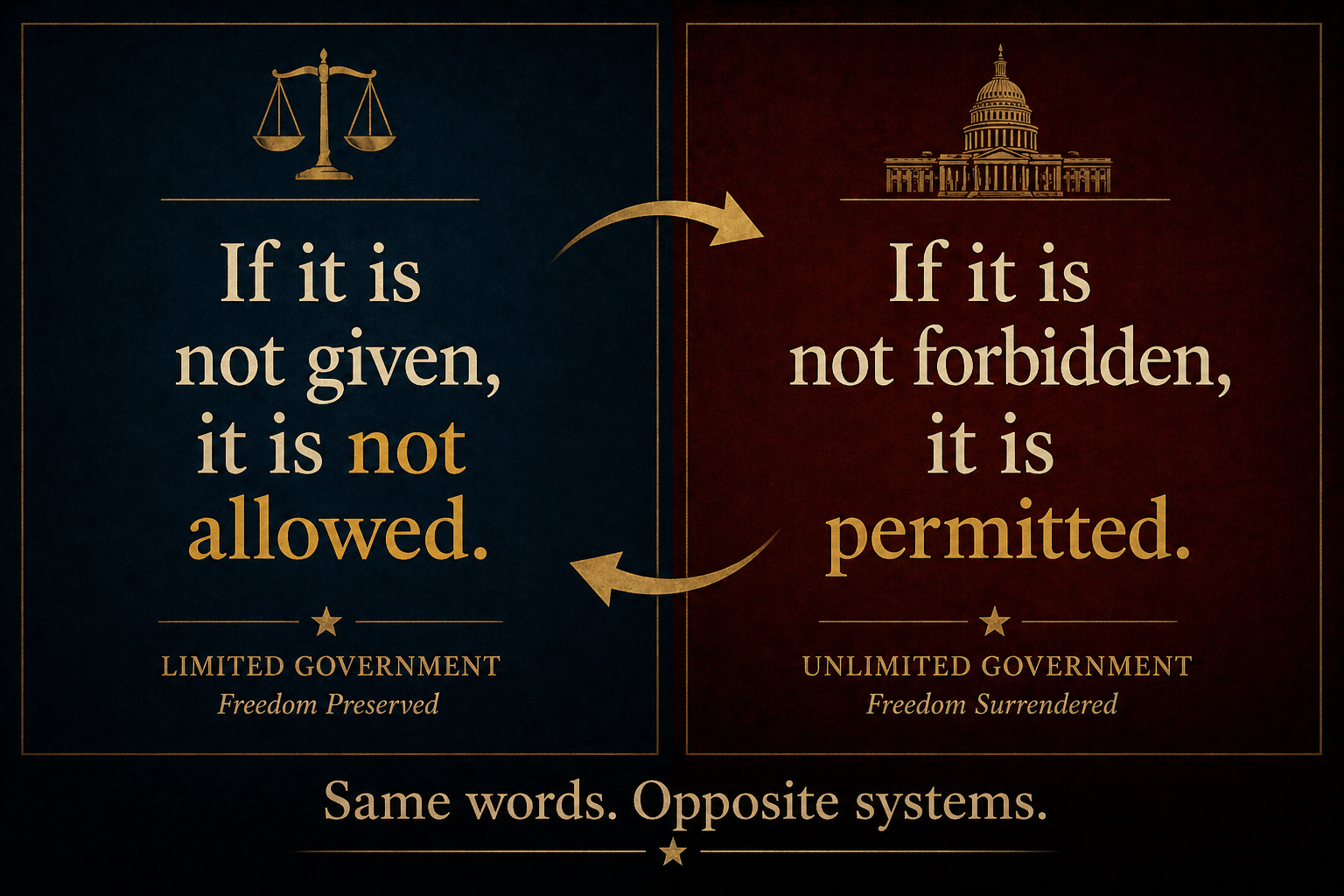
The Tenth Amendment says: if it is not given, it is not allowed.
Modern practice often says: if it is not forbidden, it is permitted.
Those are not two ways of expressing the same idea. They are opposites.
The Court has warned directly against this drift, emphasizing that there must remain “a distinction between what is truly national and what is truly local” (United States v. Morrison, 529 U.S. 598 (2000)).
This inversion is most visible in the way federal authority is justified. When Congress acts, it rarely pauses to identify a clear, enumerated source of power for each action. Instead, it relies on broad interpretations of existing powers—most commonly the Commerce Clause—combined with the flexibility of the Necessary and Proper Clause to extend its reach into areas that were once understood to be outside its jurisdiction.

he result is a federal government that operates as though it possesses a kind of residual authority, capable of addressing any issue that rises to national attention.
But that is precisely the kind of authority the Tenth Amendment denies.
In cases such as New York v. United States, 505 U.S. 144 (1992), and Printz v. United States, 521 U.S. 898 (1997), the Court reaffirmed that the federal government may not “commandeer” state governments or compel them to implement federal policies. These decisions reflect an effort to preserve a zone of state sovereignty, a recognition that the Constitution does not permit the federal government to treat the states as administrative subdivisions.
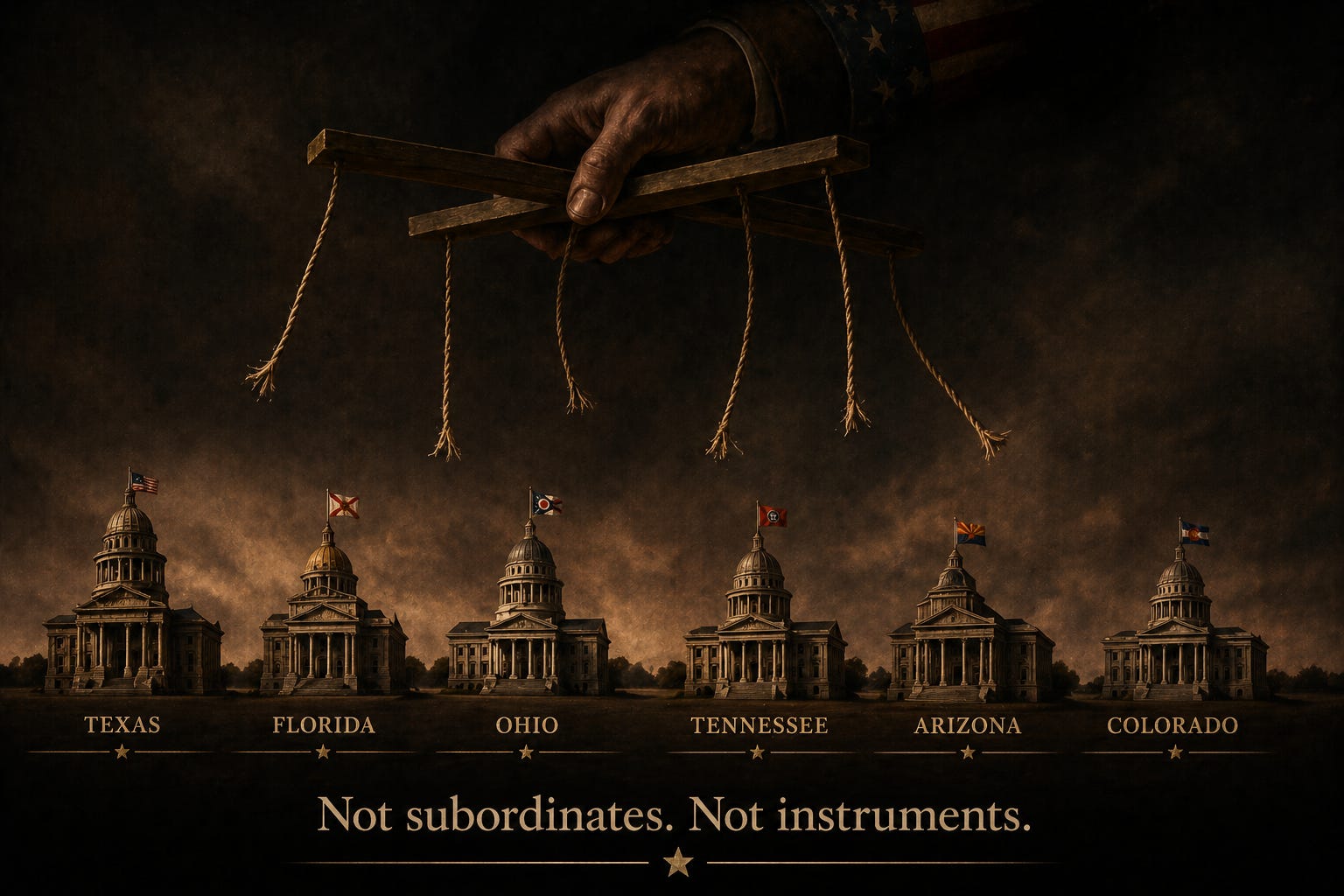
Even so, these interventions are limited. They address specific forms of overreach without fully restoring the broader principle that federal power must be grounded in enumeration. The underlying assumption—that Congress may act broadly unless restrained—remains largely intact.

What makes this situation particularly striking is that the Tenth Amendment does not require complex interpretation to apply. It does not depend on evolving standards or changing circumstances. It asks a single question, and it expects a straightforward answer:
Was this power delegated?
If the answer is yes, then the federal government may act within that scope. If the answer is no, then the matter belongs to the states or to the people.
There is no intermediate category. There is no fallback justification based on usefulness or necessity. The Constitution does not expand to meet perceived needs; it defines the boundaries within which those needs must be addressed.
The difficulty, of course, is that this approach imposes limits, and limits are rarely popular in a system that rewards action. Congress is expected to respond to problems, to address national concerns, to “do something.” The Tenth Amendment, by contrast, often requires Congress to say, “This is not our authority to exercise.”
That is not a message that fits easily into modern political incentives.
And so the amendment is acknowledged, cited, and then quietly set aside. It appears in opinions, in speeches, in textbooks, but far less often in the actual process of governing. Its language remains unchanged, but its practical force has been diminished by the habits of interpretation that have grown up around it.
The amendment did not fail. It was not repealed. It was not even seriously revised.
It was simply ignored in practice while being preserved in theory.
But ignoring it does not eliminate it.
The Tenth Amendment remains what it has always been: a statement of the fundamental principle that the federal government is one of limited and enumerated powers. It continues to draw a line between national authority and local autonomy, between what has been given and what has been retained.
And that line does not move on its own.
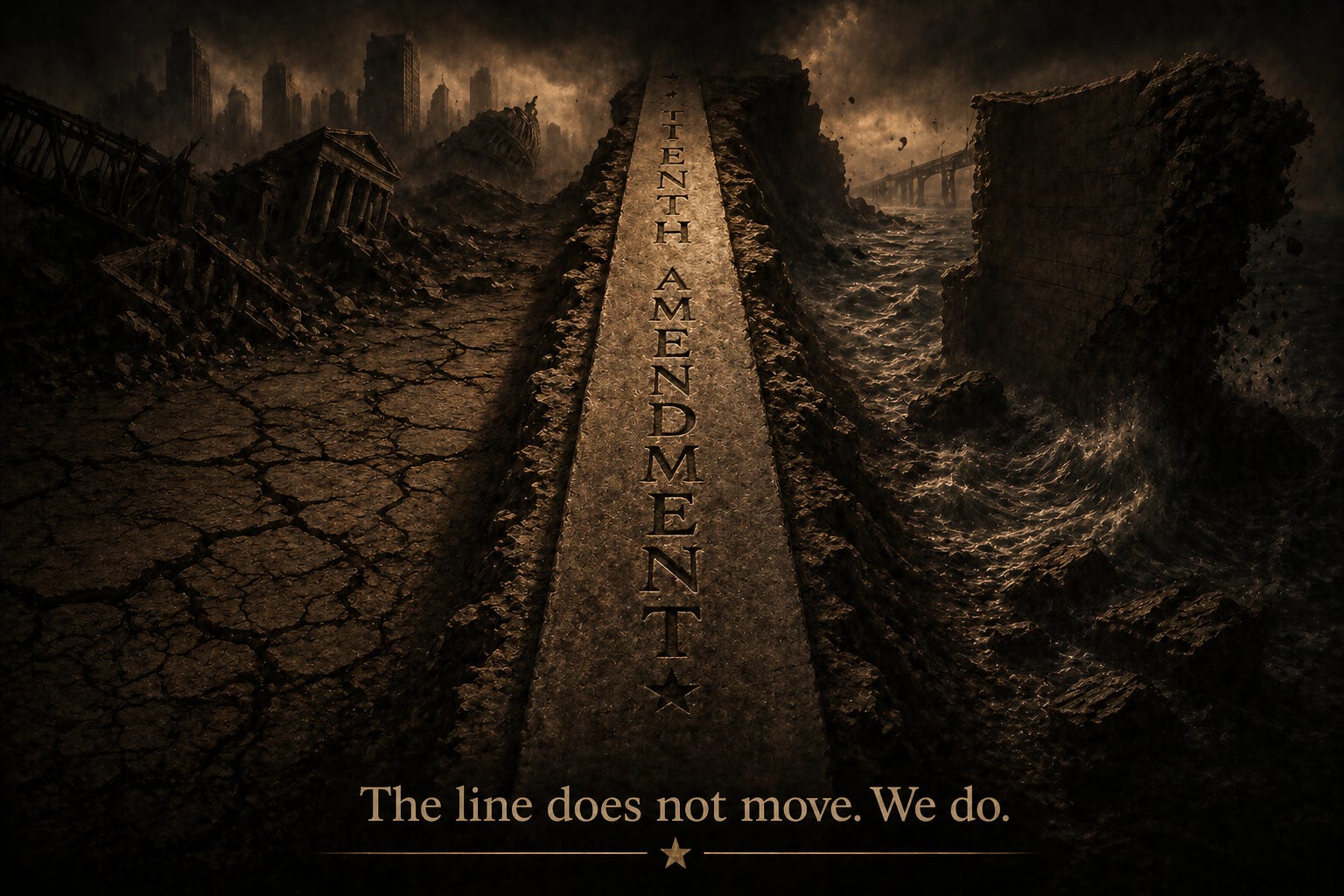
If it is to mean anything, it must be treated not as a formality, but as a rule. It must be applied not occasionally, but consistently. It must be understood not as a historical artifact, but as an active constraint on the exercise of power.
Because without that constraint, the distinction between federal and state authority begins to disappear. And when that distinction disappears, so does the structure that the Constitution was designed to preserve.
The principle itself is not difficult.
If a power is not listed, it has not been granted.
If it has not been granted, it cannot be exercised.
That is the logic of the Tenth Amendment.
The only question is whether we are willing to follow it.

Or you can Buy Me a Coffee
Extremely good article today. The federal government is an incorporation of the states. The states own the federal government and not the other way around. States lost a seat at the table with the seventeenth amendment. Many are trying to remove another seat for the states by eliminating the a Electoral College. Those two changes would open the door to run away socialism. Education has almost completely abandoned true history, civics, and patriotism. When I hire someone, I expect them to work for me and no one else. Why would we even consider giving education a pass. They call it academic freedom. What about freedom?
The key word you have is is ignored. It seems that judges, for example, that law is black and white…there is no interpretation. Or it’s supposed to be. Judges are forgetting that. There is also, as you note, a separation of the federal vs the state. But, what do you do when states do their own ignoring. Ignoring due process, ignoring law and order, ignoring what the United States is suppose to stand for. Is it not up to the federal government to get them back in line ? Back in line with the constitution and its laws ? The whole system is supposed to be a system of checks and balances. Not just Executive, Legislative and Judicial. That also should apply for States vs Federal and vice versa.