

THEY COULDN’T KILL IT
SO THEY STARVED IT

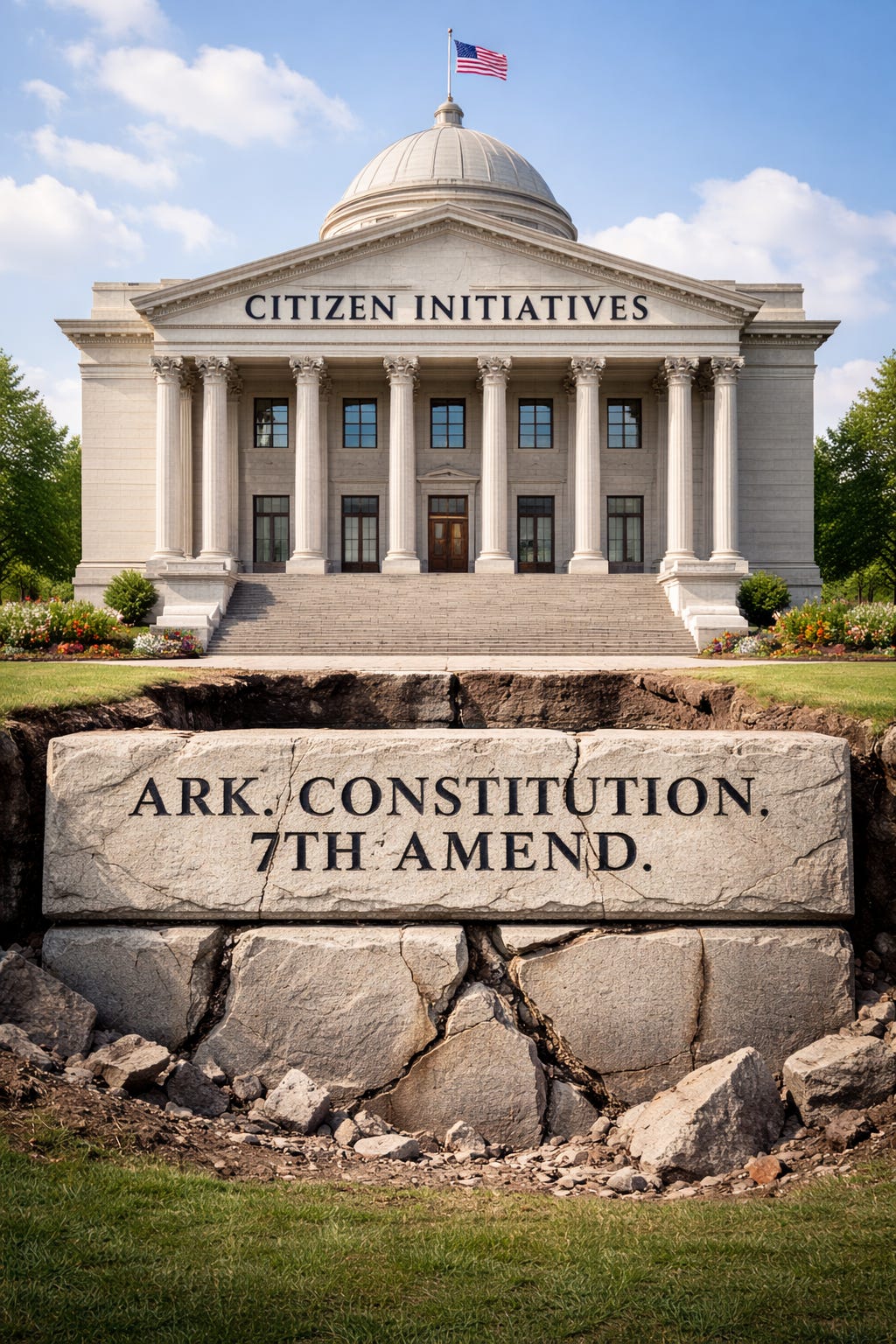
Let’s begin with the recap—because the recap matters.
In the first article, Citizen Initiatives, we established something that should not be controversial, but somehow always is: the Arkansas Supreme Court correctly recognized that the General Assembly has the power to repeal or amend a citizen-initiated law, as explicitly permitted under Article 5, Section 1 of the Arkansas Constitution.
That power exists. It always has.
But here’s the part the political class never wants to read out loud—the part they hope you won’t read at all:
“This section shall be self-executing, and all of its provisions shall be treated as mandatory…
No legislation shall be enacted to restrict, hamper or impair the exercise of the rights herein reserved to the people.”
— Arkansas Constitution, Article 5, §1 (Amendment 7)
That sentence is not decorative.
It is not optional.
It is not “guidance.”
It is a command.
And under that command, the State of Arkansas is explicitly forbidden from implementing:
added hurdles
procedural sabotage
back-door restrictions
bureaucratic choke points
Arkansas courts themselves have repeatedly cited this exact language when striking down legislative interference. The people’s right to initiate laws is not a favor granted by the General Assembly—it is a right reserved against it.
And yet.

Since roughly 1950, the State of Arkansas has done almost everything except openly repeal Amendment 7—choosing instead a slower, quieter, more dishonest approach.
They didn’t kill it.
They starved it.
THE LONG WAR AGAINST AMENDMENT 7
Let’s stop pretending this happened by accident.
Yes, the Arkansas government—through legislative actions, court rulings, and administrative maneuvering—has systematically weakened the citizen initiative process for over seventy years.
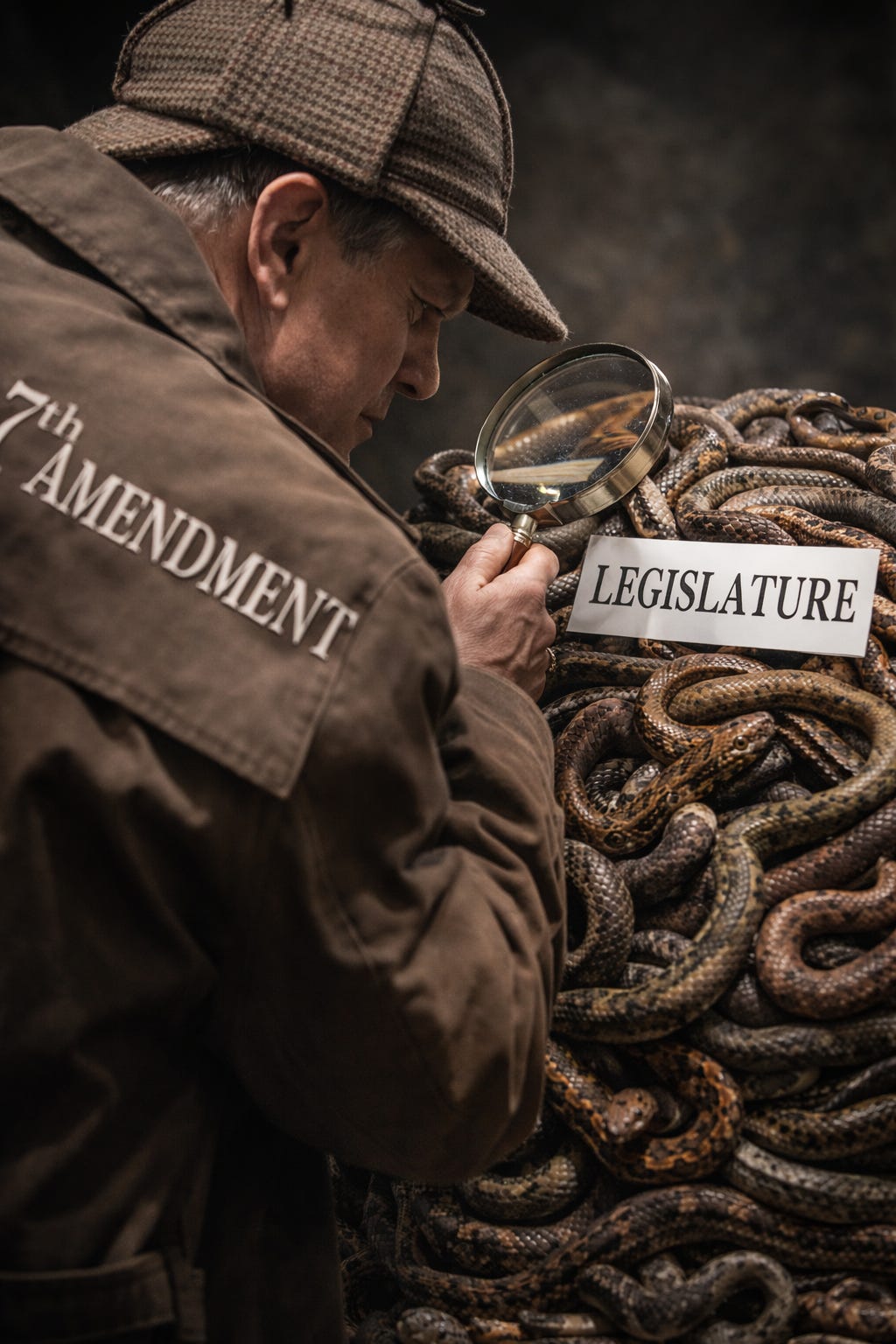
The cumulative effect has been unmistakable: making ballot initiatives harder to qualify, harder to pass, and easier to dismantle after passage.
The official excuse is always the same:
“Preventing fraud.”
“Ensuring clarity.”
“Protecting voters.”
The actual result?
A neutered Amendment 7 and a people boxed out of their own Constitution.
Amendment 7 was adopted in 1920 to give citizens a direct check on a legislature that—then as now—was more responsive to insiders than to voters. What followed after mid-century was not reform, but attrition by a thousand paper cuts.
EARLY SIGNS: THE COURTS CHANGE THE RULES (1950s–2000s)
The shift begins in the early 1950s, when the courts quietly changed the burden of proof.

In Ellis v. Hall (1952), the Arkansas Supreme Court ruled that when signatures were flagged as potentially forged, initiative sponsors—not the state—had to prove their authenticity. This reversed earlier presumptions of good faith and effectively treated citizens as suspects first and participants second.
Then came Washburn v. Hall (1956), which upheld a 1943 statute requiring Attorney General pre-approval of ballot titles. The Court labeled it “facilitative.”
Let’s translate that.
When government says facilitative, it usually means controlling.
Another gate was installed. Another delay introduced. Another chance to kill a proposal quietly before voters ever see it.
The numbers tell the story the rhetoric won’t.
1950s: 18 initiatives, ~50% passage rate
2010s: 4 initiatives, ~50% passage rate
Same success rate.
Near-total collapse in access.
That is not voter apathy.
That is procedural strangulation.
DEATH BY JUDICIAL WHIPLASH
In Finn v. McCuen (1990), the Court briefly did its job—striking down a 1989 law that allowed piecemeal judicial review of ballot titles before signature collection was complete. The ruling recognized the obvious: early intervention could be weaponized to derail initiatives before they ever got off the ground.
Ten years later, that protection vanished.
In Stilley v. Priest (2000), the Court reversed course, reopening the door to early judicial scrutiny—allowing initiatives to be litigated into oblivion before a single voter signs a petition.
If Amendment 7 is a right, this is the equivalent of demanding a permit to speak before you open your mouth.
THE MODERN ERA: ACT 1413 AND THE CRIMINALIZATION OF PARTICIPATION
Then came the 2010s—when Arkansas stopped pretending.
Act 1413 of 2013 wasn’t reform.
It was a declaration of war.
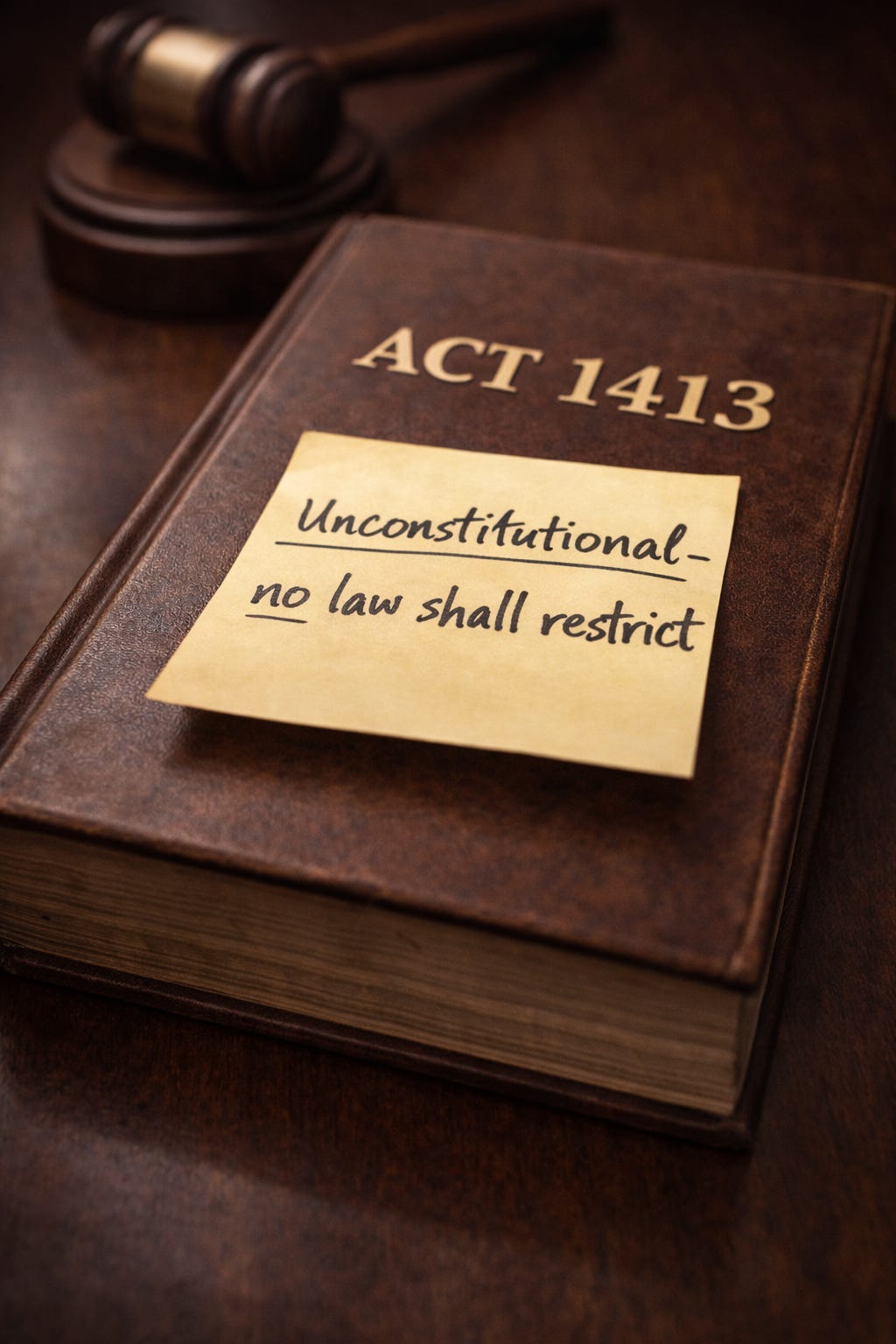
Among its “highlights”:
Criminal penalties (Class A misdemeanors) for paperwork violations
Mandatory disclosure of canvasser names, home addresses, photos, and criminal histories
A forced moratorium on signature collection during Secretary of State review
Invalidation of entire petition pages for minor or technical defects
In plain English:
Volunteer participation was chilled.
Paid canvassing was crippled.
Mistakes were criminalized.
And citizen engagement was treated as suspicious activity.
All of it done under the banner of “integrity.”
All of it in direct tension with the Constitution’s command that no law shall restrict, hamper, or impair the people’s right.

THIS WAS NEVER ABOUT FRAUD
Let’s be blunt.
If this were about fraud, Arkansas would target fraud.
If this were about clarity, Arkansas would simplify the process.
If this were about voters, Arkansas would trust them.
Instead, the state built a maze—then punished citizens for getting lost in it.
Amendment 7 still exists on paper.
But in practice?
It has been wrapped in red tape, buried under procedure, and guarded by gatekeepers who answer to the very legislature the amendment was meant to restrain.
The people were supposed to be a check on power.
Power decided it would rather be checked by paperwork.
And that brings us—finally—to the real reason for this article.
Because what Arkansas has done to Amendment 7 is not an accident.
It is not neutral.
And it is not over.
The question now isn’t whether the people’s power has been weakened.
The question is whether Arkansans are willing to reclaim it—or let it finish dying quietly.
Your choice, your freedom. What will you do?

Or you can Buy Me a Coffee
We need a citizens amendment that cleans out the traps that have been placed in the system and will prevent changes by the legislature. We need that amendment in 2026.
You're getting awfully close to the fire. Watch your back, Jack And stay strong..